Why cutting running shoes in half is key to measuring midsole softness


In the RunRepeat lab, we ensure precise midsole softness measurements by first cutting the shoe in half.
This approach allows us to apply the durometer directly to the actual foam, giving us accurate and reliable results. It’s a costly process because we purchases the shoes with our own money, and that’s probably why most running websites and YouTube channels simply measure the durometer on the exterior of the midsole. However, there’s a problem with that.
Applying the durometer on the outside of a running shoe can be misleading, as it always fails to accurately capture the midsole's true softness.
This inaccuracy stems from the hard, protective outer layer present in most running shoes, which varies significantly from one shoe to another. Furthermore, the outer surface of shoes often has numerous contours and bumps.
Unpacking insights from interior and exterior durometer readings in midsoles

We've specifically tested 33 shoes for this guide, both internally and externally, to prove why exterior measurements fall short in revealing the true nature of a running shoe.
Here you can check out all the data in the table below. Keep in mind, a lower AC reading indicates a softer material:
If you're more visually inclined and prefer charts over tables, we've got you covered too:

Two examples proving why cutting shoes is essential
To better understand these significant differences among running shoes, we will closely examine two standout examples.
ASICS Novablast 6
As we said before, some models feature exceptionally hard protective layers (trail running shoes) while others like racing shoes might have softer ones, greatly influencing the external durometer readings.
The ASICS Novablast 6 serves as a perfect example of how external measurements can be deceptive. When we cut the shoe in half, the true nature of the midsole is revealed, showing that the external layer bears little resemblance to the exposed foam inside. Furthermore, the shoe features a dual-foam configuration that is impossible to properly assess from the exterior of the shoe.
- Internal measurement (main foam): 35.1 AC
- External measurement: 49.6 AC
- Difference: 47%

The contrast between the accurate measurement taken directly on the foam and the measurement made on the exterior of the shoe is clear in the Novablast 6.
Saucony Endorphin Elite 3
The Saucony Endorphin Elite 3 also stands out as a terrific example of why midsole measurements should be taken from cut sections of running shoes. This premium super shoe features the excellent IncrediRUN foam and is known for its ultra-soft ride. However, its external measurement was far from plush at 33.0 AC, resulting in a staggering 113% difference compared with the reading taken directly on the exposed foam.

The reason behind this discrepancy lies in the shoe's construction. Saucony protected the IncrediRUN foam with a harder outer layer to improve durability. Consequently, the external measurement is misleadingly high, reflecting the protective layer rather than the incredibly-plush foam underneath.
How durometers measure running shoe softness

You might be thinking: "Alright, I get why you guys at RunRepeat need to cut the shoe in half to check its softness, but what about the tool used for this measurement? How exactly does that small device work?"
A durometer is a tool we use to measure how soft or firm a material is. For years, we used the Shore A (HA) scale for running shoe midsoles. However, in February 2026, we switched to an Asker C (AC) durometer because it is better at measuring very soft foams, which are now common in modern running shoes. We use Asker C for all our midsole softness tests, including the main foam, secondary foam, and cold-weather measurements. And yes, we backtested all shoes.
The Asker C durometer works by pressing a small tip into the foam and measuring how much it resists the pressure. A lower AC number means softer foam, while a higher number means firmer foam.
The dimensionless nature of durometer measurements

It’s important to understand that softness is a relative, dimensionless measurement. This means that a material's hardness is determined in relation to the hardness of other materials, but only when measured using the same durometer scale. The comparison is valid and meaningful within this context, as it maintains a consistent reference point for evaluation.
Think of a durometer like a special ruler that doesn't use regular units like inches or centimeters. Instead, it pushes a pointy tip into a material, like the foam in a running shoe, and sees how deep it can go.
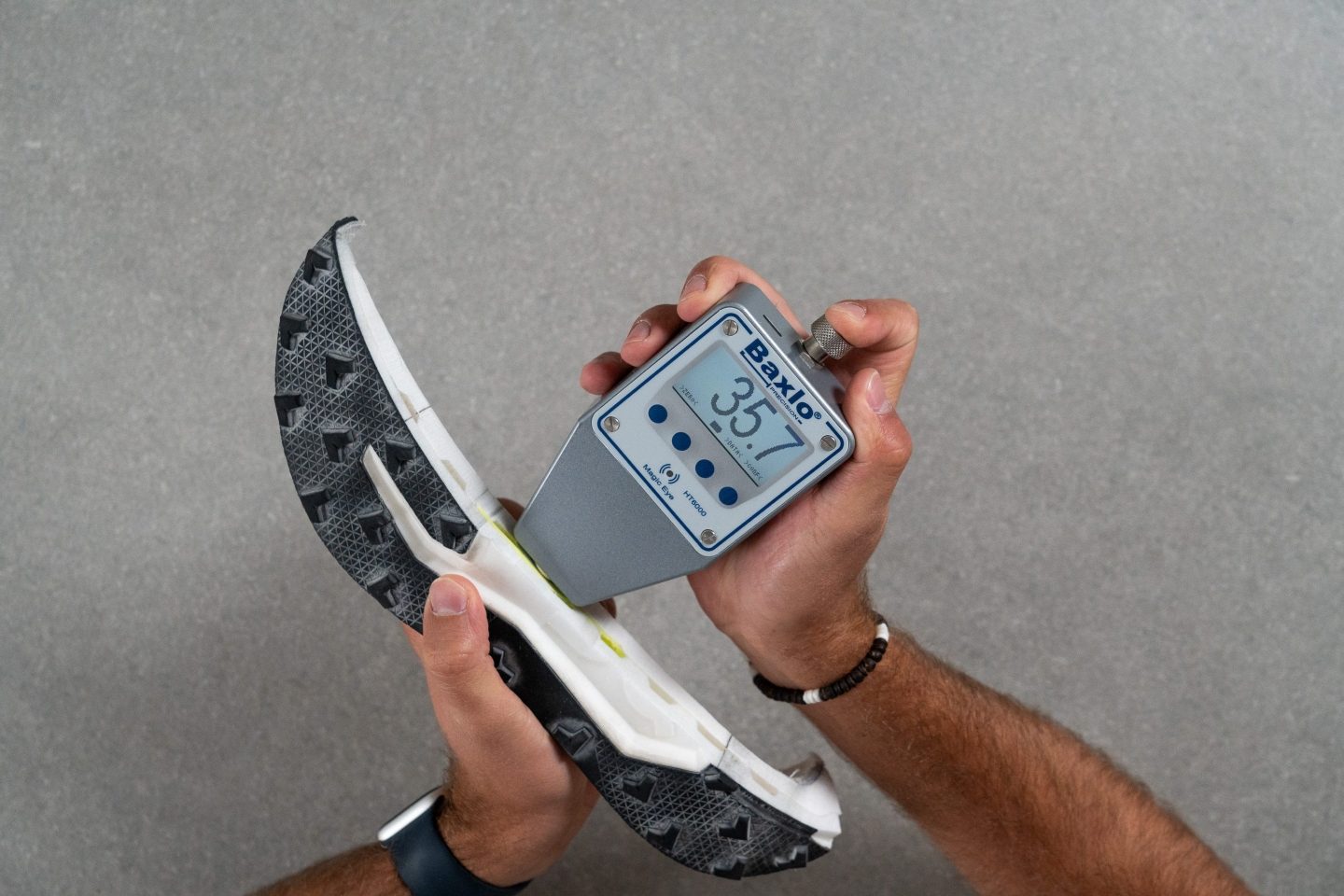
The deeper it goes, the softer the material. However, AC is a scale, not a physical unit like inches or centimeters. It simply gives us a number that indicates how soft or firm the material is compared with other materials measured on the same scale.
Furthermore, even two Asker C durometers can produce slightly different readings due to factors such as calibration, wear, and manufacturing differences. Therefore, we always use the same durometer to ensure consistent and reliable comparisons.
Final thoughts
While measuring midsole softness with a durometer on a shoe that's been cut in half is not an absolutely perfect method for gauging a shoe's softness—since it doesn't account for factors like the outsole rubber or the influence of a carbon plate—it remains the best approach as of today. And this method is our go-to until a more advanced or accurate way of measuring midsole softness is developed.
And as you probably guessed, this effective method applies only to shoes that have been cut in half, because attempting to measure midsole softness from the exterior leads to unreliable and imprecise results. Such inaccuracy not only misleads runners, but can also contribute to them making wrong choices when purchasing the next pair running shoes.